
 First of all, from one time traveler to another, happy 79th birthday to Tom Baker, better known to some as the 4th Doctor and to many as “That British guy with the hat and the crazy scarf…”
Aside from being my first Doctor, he was also a gifted Shakespearean actor and a member of Sir Laurence Olivier’s company. I’d give anything to see him play Lear. Regardless of all that, to me and millions of others, he’s the mad man in the blue box.
From the other crazy hat/scarf guy getting himself lost in the time stream, many, many more happy years, sir.
Seriously, folks. If you didn’t realize I was geek by now, you just haven’t been paying close enough attention.
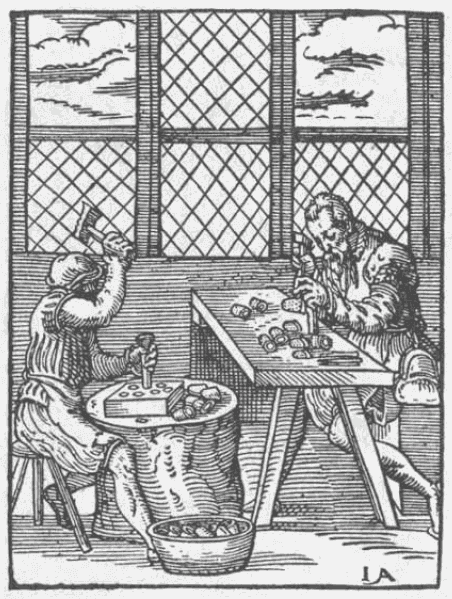 |
| “Der Fingerhueter”, from Das Ständebuch by Jost Amman |
Thankfully, while I was failing miserably at the fine art of thimbling, the books on coopering arrived from England. So, after I gave up on making finger helmets, I spent some time knocking together a shaving horse.
Here’s a video for going on with. It’s done by Kari Hultman, who is the woodworker behind the fantastic “Village Carpenter” blog. It’s an extended interview and demonstration of coopering at Colonial Williamsburg, including the shaving horse I’m working on…
Here’s to a more successful day tomorrow!
~Scott
Ramona Vogel: Journeyman Cooper at Colonial Williamsburg from Kari Hultman on Vimeo.
 The Renaissance Artisan Project
Are you heating and quenching the brass before you start? Modern brass is supplied as either half hard or hard, making it easier to handle and ship, but harder to work. Heat it to red heat and then quench in water. You may need to repeat part way through if it work hardens.
LikeLike
Good advice! Work hardening is a real possibility, as you pound on metal you reduce the spaces between the molecules making it stiffer with each stroke. Start with heavier metal, cupping a sheet of metal to make a thimble essentially increases the volume the metal has to fill, while rearranging it into the new form. And starting with a softer metal might help. both silver and copper are easier to work. Copper however makes a black oxide when you heat it (well, so does silver, just not a much).
LikeLike
That makes perfect sense. I guess I should've thought of that; metal shop was a long time ago.
Funny… almost all of the information online about doing it are specific to reloaders. I suppose it's much the same thing except a thimble won't blow up on you if you do it wrong.
LikeLike